Book
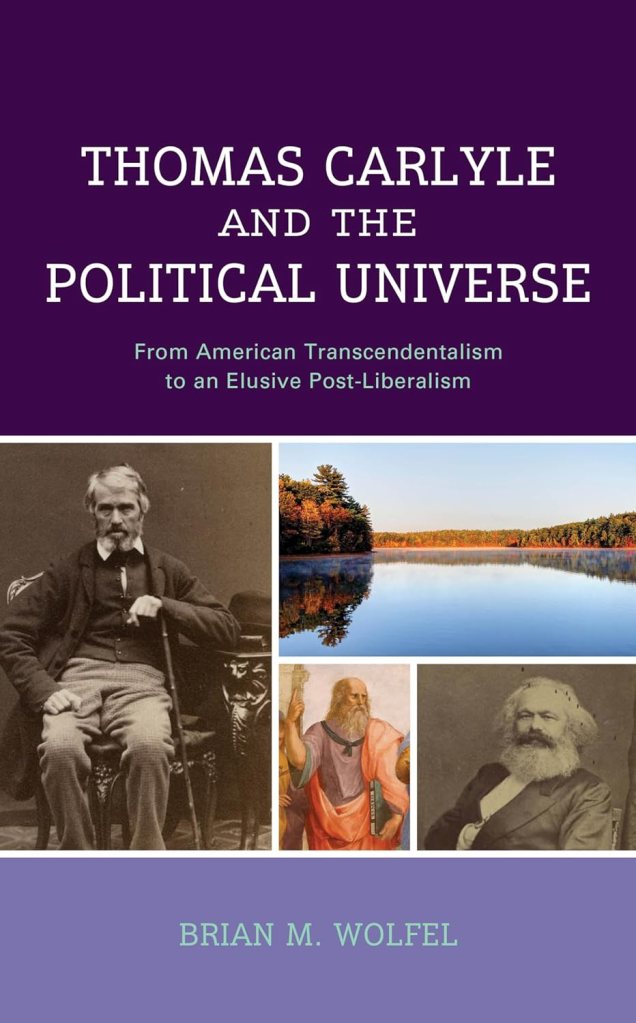
Please purchase my new book at: https://www.amazon.com/Thomas-Carlyle-Political-Universe-Transcendentalism/dp/1666954233
DESCRIPTION:
Thomas Carlyle and the Political Universe: From American Transcendentalism to an Elusive Post-Liberalism recognizes and reckons with Thomas Carlyle’s broad and deep influence on politics, on a global scale. Having influenced and inspired iconic and impactful political thinkers and actors such as Ralph Waldo Emerson, Henry David Thoreau, John Stuart Mill, Charles Dickens, Karl Marx, and Martin Luther King Jr., among so many others, Carlyle is a captivating persona in modern political history. In this way, if there is one person who could be said to be the central figure of what may be called the “political universe,” all that the term politics comprises, Brian Wolfel argues that it is Thomas Carlyle. As the point of nexus of so many political figures embodying such a diversity of political persuasions, Carlyle is also a significant philosopher in Plato’s lineage whose ideas can be further constructed and developed in the context of the work of prominent 20th-century political thinkers such as John Rawls, Alasdair MacIntyre, Jacques Ellul, and Sayyid Qutb. Carlyle’s conceptualization of transcendentalism in Sartor Resartus was a foundation for Emerson, Thoreau, and American Transcendentalism. In the midst of ideological battle in the 20th and 21st centuries, among such ideologies as liberalism, communism, fascism, and Islamism, Carlyle’s transcendentalism largely went unnoticed as a potential ideological competitor. Carlyle’s transcendentalism can be developed and constructed in the contexts of modern political theory and religion, and can be defended and promoted as a potential post-liberalism, a refinement of and evolution from liberal democracy and capitalism.
REVIEWS:
“In this refreshingly thoughtful and uninhibited study, Wolfel distinguishes Carlyle from his Victorian contemporaries by emphasizing his heroic resistance to the materialist blueprints of Adam Smith, Jeremy Bentham, John Stuart Mill, and Karl Marx. The Sage of Chelsea emerges from this study wearing clothes that might surprise his modern detractors: in his prescient attacks against the environmental, political, and economic degradation of his times, Wolfel’s Carlyle reclaims the mantle of a prophet.”
— David R. Sorensen, Saint Joseph’s University
“Bringing Carlyle’s Sartor Resartus into dialogue with the work of Rawls, MacIntyre, Ellul, Qutb, and others, Brian Wolfel argues thoughtfully and provocatively for the twenty-first century relevance of Carlyle’s transcendentalist philosophy, conceived here as an anti-dogmatic, post-liberal political ideology with the potential to move us beyond the limitations hyper-consumerism and political factionalism.”
— John M. Ulrich, West Chester University and co-editor of the Strouse edition of Carlyle’s Essays on Politics and Society
“In this book, the first of its kind to analyze Thomas Carlyle systematically as a political theorist, Brian Wolfel provides a view of Carlyle’s anti-liberal legacy which is a timely and useful contribution to scholarship. Carlyle’s neo-Platonic approach to spirituality exposes the vulnerabilities and diminishing returns inherent to dogma and materialism. In Wolfel’s analysis, the decline of attention to this aspect of his legacy reflects the decline of the humanities as a whole, and Carlyle’s re-positioning formulates their defense by offering a post-liberal vision beyond capitalism and individualism.”
— Zoe Beenstock, University of Haifa
TABLE OF CONTENTS:
Introduction
Chapter 1: The Scope of Thomas Carlyle in the History of Political Thought
Chapter 2: Carlyle’s Latter-Day Pamphlets and the Limits of Political Theory
Chapter 3: Carlyle’s Transcendentalism as a Platonic Political Philosophico-Religion: A Comparison of Transcendentalism with Islam and Islamism
Chapter 4: The Antagonism of Thomas Carlyle and John Rawls
Chapter 5: Carlyle’s Construction of Justice and Contemporary Political Philosophy
Chapter 6: Carlyle, Ellul, and Their Critiques of Modernity
Chapter 7: Carlyle’s Theory of the Phoenix and the Dissolution of Liberalism?
Conclusion: Carlyle’s Transcendentalism and a New Stage of Political Development?
Recent Articles
“American Transcendentalism and the Twenty-First Century.” Utopian Studies 33 (2): 291-316.
“Thomas Carlyle’s Conception of Transcendentalism in Sartor Resartus and its Application to Theorizing Post-Liberalism.” Telos 199 (Summer 2022): 125-149.
“From Islamism to Transcendentalism,” Modern Diplomacy, 8 Nov. 2020.
“The COVID-19 Pandemic and the “Phoenix” of the Globalized Technological Capitalist System?,” Modern Diplomacy, 5 Jun. 2020.
“How Emerson and Thoreau’s Transcendentalism Could Inspire a Re-Awakening (and Consensus?) After the COVID-19 Pandemic,” Resilience, 1 Jun. 2020.
A core focus that anchors my research is a normative application of the ideals sprung from American Transcendentalism as a 19th century Platonic intellectual and social movement. Transcendentalists such as Ralph Waldo Emerson, Thomas Carlyle, and Henry David Thoreau forecasted the cataclysm of modernity that was increasingly being defined in the 19th century by the hegemony of commercialism, economic individualism, and dogmatic/incommensurable political doctrines. I have sought to apply Transcendentalism to nascent academic literature on post-liberalism (and now the recent COVID-19 pandemic) to construct Transcendentalism as itself a political doctrine that has been undeveloped and unrecognized. Though Transcendentalism re-emerged, albeit informally and unconsciously, in the context of the 1960s-1970s with the emergence of the counterculture/New Age, I argue that it offers a potential mainstream application in the 21st century political climate marked by a youth generation increasingly disillusioned with partisan politics, religious and political dogmatism, and the state of the economy.
Specifically, my dissertation, “American Transcendentalism Contra Contemporary Political Philosophy,” explores European Romanticism and American Transcendentalism as neglected political traditions to theorize social justice. Thomas Carlyle’s Sartor Resartus is considered a preeminent Romantic text and it serves as a foundation for my discussion of Romanticism vis-à-vis influential political theory of the 20th century by such philosophers as John Rawls, Alasdair MacIntyre, Jacques Ellul, and Sayyid Qutb. By doing such, I dialogue Romanticism with liberalism, Aristotelianism, criticism of technology, and Islamism to situate Carlyle’s Platonic theory of transcendentalism as a heretofore unrefined political doctrine. Moreover, I assert that Carlyle’s theory of transcendentalism has the capacity to resolve seemingly intractable political problems in the early 21st century such as ideological and partisan polarization, racism, economic inequality, economic exploitation, and international conflict among nation-states. Though Sartor Resartus inspired American Transcendentalists Ralph Waldo Emerson and Henry David Thoreau and was a foundational text for American Transcendentalism as an intellectual movement, it did not inspire the development of a popular political ideology to compete alongside other prominent 20th century ideologies such as liberalism, communism, fascism, and Islamism. Carlyle himself theorized in Sartor Resartus that liberal democratic capitalism would come to full form after roughly two centuries (in the 21st century) and a new order would emerge phoenix-like due to the unsustainable nature of continuously growing complexity, inequality, and atomized individualism in the context of free market capitalism.
 Brian Wolfel